Back
Global Security

Potential benefits of next-generation wargames
Technological advances for game engines and cloud architectures are fueling the development of next-generation wargames that can increase insights for policymakers, according to the authors of a paper published today. In an article appearing in the Dec. 21 edition of Science Magazine, researchers from Lawrence Livermore National Laboratory (LLNL), Sandia National…
Uncovering secret structure to safer explosives
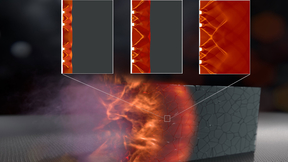
A team of scientists at Lawrence Livermore National Laboratory (LLNL) has shown that the structure of microscopic pores in high explosive materials can significantly impact performance and safety. These findings -- published recently as the cover article in the journal Propellants, Explosives, Pyrotechnics -- open the door to the possibility of tuning high explosives by…
Theory aids analysis of nuclear materials
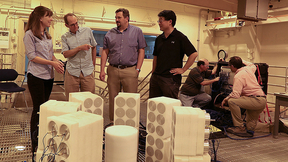
Nuclear emergency teams, safeguards specialists and others may one day benefit from an expanded nuclear fission chain theory and detectors developed by a team of Lawrence Livermore Nationla Laboratory (LLNL) physicists. The Livermore scientists have bolstered their theory for understanding nuclear fission chains -- a cascade of atomic nuclei splitting, each initiated by a…
LLNL-led team expands forensic method to identify people using proteins from bones
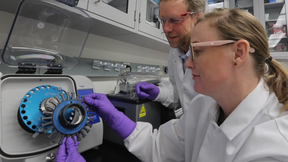
When a team of researchers led by Lawrence Livermore National Laboratory (LLNL) developed a new biological identification method that exploits information encoded in proteins, they thought it could have multiple applications. Nearly two years later, they’ve turned out to be right. In September 2016, LLNL scientists announced they had developed a science-based,…
New Center for Global Security Research book explores dark side of new technologies
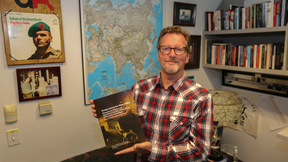
A new book by the Lawrence Livermore National Laboratory's (LLNL) Center for Global Security Research (CGSR) explores the military and security implications of emerging and disruptive technologies. The latest in its strategic latency series, "Strategic Latency Red, White and Blue: Managing the National and International Security Consequences of Disruptive Technologies,"…

Lawrence Livermore to lead United States-United Kingdom consortium for demonstrating remote monitoring of nuclear reactors
LIVERMORE—Harnessing the unusual characteristics of the elusive subatomic particles known as antineutrinos, Lawrence Livermore National Laboratory (LLNL) will lead a new international multi-laboratory and university collaboration for nonproliferation research. The program will support the development of detection hardware and algorithms to enable improved nonproliferation…
FSC earns 8th straight A in OPCW tests
During its 15 years as a certified laboratory for the Organization for the Prohibition of Chemical Weapons (OPCW), a score of Lawrence Livermore National Laboratory (LLNL) chemists have developed some first-rate habits. One of them is earning A grades on the organization's environmental proficiency tests. In recently announced results, LLNL earned its eighth straight A…
Plutonium research to advance stockpile safely
Conducting an experiment that combines high explosives with plutonium -- a special nuclear material used in nuclear weapons -- is no trivial matter. Not only do researchers need to ensure the plutonium remains "subcritical" to avoid a nuclear explosion, they must be absolutely certain that these materials are confined in a worst-case scenario. On top of that, they have to…
LLNL supports ICBM flight tests
As an unarmed Minuteman III intercontinental ballistic missile (ICBM) rocketed into the night sky, a team of Lawrence Livermore National Laboratory (LLNL) researchers listened intently to radio chatter and watched flight data stream in from a control room at the Ronald Reagan Ballistic Missile Defense Test Site. It was the first of two flight tests conducted recently to…
Alliance yields first class of explosives handlers
A dozen Lawrence Livermore National Laboratory (LLNL) employees were honored last week as graduates of the inaugural class of an innovative new Explosives Handler Training program conducted in partnership with Texas A&M Engineering Extension (TEEX). LLNL has conducted training of this sort independently for decades, but with an outflow of retirees and an influx of…

International anthrax conference to explore latest scientific research findings
Scientists and researchers from all over the world who work on Bacillus anthracis, the causative agent of anthrax, and B. cereus and B. thuringiensis, two closely related bacillus species, will be heading to Victoria, British Columbia, in October for the international conference known as "Bacillus ACT." The bi-annual conference, set for Oct. 1-5, will allow members of the…
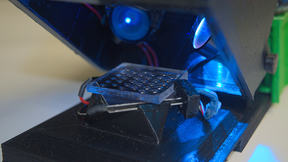
A new toolkit for rapid bacterial detection
Finding the right treatment plan for patients who have antibiotic-resistant infections is a costly and time-consuming effort. For doctors in rural areas or developing countries, there often is no source of electricity nearby or sterile lab conditions with microbiology specialists on hand. The current standard for bacterial identification is to isolate and grow the species…
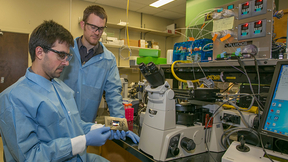
Fund aids commercialization efforts
For three Lab engineers, a Lawrence Livermore National Laboratory (LLNL) commercialization fund has proven to be an oasis of assistance as they have sought to cross the legendary technology "valley of death."In technology transfer circles, there is a phase -- between when a technology is promising and when it moves forward into commercialization -- known as the "valley of…
Lawrence Livermore geophysicist receives NNSA Administrator's Gold Award
Lawrence Livermore National Laboratory geophysicist and a leader in the Global Security Principal Directorate Jay Zucca has received one of the National Nuclear Security Administration’s (NNSA) top awards for his work in nonproliferation and nuclear security.Zucca, principal deputy for Global Security, was presented with the NNSA Administrator’s Distinguished Service Gold…
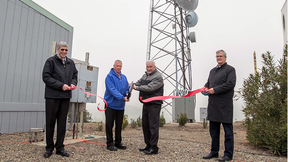
'Can you hear me now?' Site 300 cell service
Employees gathered in the hills between Livermore and Tracy on Tuesday to celebrate the addition of cellular service at Site 300. The celebration took place at the foot of a tower used to mount cellular antennas, one of four antenna locations that now provide coverage to much of the developed areas of the 7,000-acre experimental site. The driver behind the investment:…
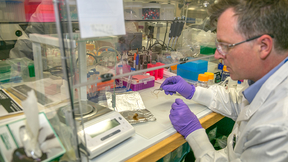
Splitting hairs to advance forensic science
With initial help from his work at a Utah university, an Australian-born biochemist is partnering with Lawrence Livermore National Laboratory (LLNL) to discover a second science-based forensic tool for identifying people in addition to DNA profiling. Now an LLNL contract employee, Glendon Parker is working with the Lab's Forensic Science Center employees to develop a…
Lab physicist receives DoD award
Lab employee Craig Wuest has received one of the top civilian awards from the U.S. Department of Defense (DoD). A citation accompanying the award - the Office of the Secretary of Defense Medal for Exceptional Public Service – highlights Wuest’s work to strengthen DoD’s nuclear survivability posture and his role as executive secretary for the Defense Science Board Task…

Lawrence Livermore, NY company collaborate on power capacity for portable sensors
A team of Lawrence Livermore National Laboratory (LLNL) scientists has begun collaborating with a New York company to improve its manufacturing process and increase the power source storage capacity of the firm’s portable sensors.Lab researchers are working with Ithaca, New York-based Widetronix under a $250,000 project financed by the Small Business Voucher (SBV) Pilot, a…
Experiment aims to advance nuclear monitoring
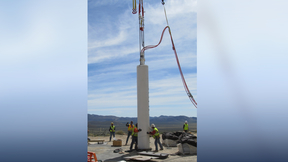
A Lawrence Livermore National Laboratory (LLNL) team played a key role in fielding the recent Source Physics Experiment (SPE-5) detonated at the Nevada Nuclear Security Site (NNSS).The SPE shots, including the most recent one on April 26, consist of a series of six underground high-explosive detonations in hard rock that are designed to improve the United States’ ability…

LLNL biodetection system bound for space
A biological detection system developed by Lawrence Livermore National Laboratory (LLNL) scientists that has found more than a dozen applications soon will be used in tests reaching a new frontier — outer space.The Lawrence Livermore Microbial Detection Array (LLMDA) is a versatile tool that has been employed for all kinds of studies, from analyzing the purity of infant…