Back
Materials Science

Manufacturing optimized designs for high explosives
When materials are subjected to extreme environments, they face the risk of mixing together. This mixing may result in hydrodynamic instabilities, yielding undesirable side effects. Such instabilities present a grand challenge across multiple disciplines, especially in astrophysics, combustion and shaped charges — a device used to focus the energy of a detonating explosive…
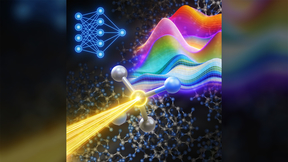
Accelerating material characterization: Machine learning meets X-ray absorption spectroscopy
Lawrence Livermore National Laboratory (LLNL) scientists have developed a new approach that can rapidly predict the structure and chemical composition of heterogeneous materials. In a new study in ACS Chemistry of Materials, LLNL scientists Wonseok Jeong and Tuan Anh Pham developed a new approach that combines machine learning with X-ray absorption spectroscopy (XANES) to…

Lab scientist wins DOE Howes Scholar award for work in computational science
Lawrence Livermore National Laboratory (LLNL) postdoc Kyle Bushick has garnered the 2024 Frederick A. Howes Scholar award for technical excellence, leadership and character in his innovative use of atomistic simulations to understand quantum processes and as a champion of inclusivity and community building. “Learning I was selected as a Howes Scholar was an enormous honor…

Meet LLNL: polymer chemist Johanna Schwartz
As a Jewish American, Johanna Schwartz believes she’s benefited from others’ mitzvah through mentorship, being included in team settings and receiving support when navigating life and career-path decisions. In Hebrew, mitzvah translates to commandment, but is generally understood as “a good deed,” or conscious acts of empathy and kindness. These decisions led her to…
Celebrating LLNL researchers on World Intellectual Property Day
World Intellectual Property (IP) Day is Friday, April 26. World IP Day shines a light on the important role innovation plays in achieving the United Nations’ (UN) 17 Sustainable Development Goals (SDGs), which aim to create a better future for everyone by protecting the planet. Lawrence Livermore National Laboratory’s (LLNL)’s Innovation and Partnerships Office (IPO) is…
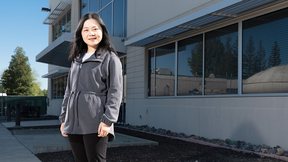
Going with the flow: research dives into electrodes on energy storage batteries
As a grid-scale energy storage system, flow batteries have gained increasing attention as a means to address the challenges associated with fluctuations and intermittency in renewable energy sources. Vanadium redox flow batteries (VRFBs) have emerged as promising solutions for stationary grid energy storage due to their high efficiency, scalability, safety, near room…

LLNL’s Kate Elder honored with Fulbright foreign scholarship
Lawrence Livermore National Laboratory (LLNL) materials scientist Kate Elder has been selected as a Fulbright U.S. Scholar and will conduct research in Finland. Elder’s project, “Establishing Process-Structure Links During Additive Manufacturing of High Entropy Alloys,” will lead to the manufacture of lighter and stronger parts, perfect for high-temperature applications…
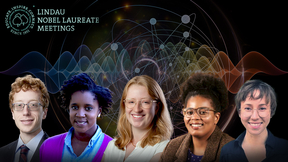
Five Lab postdocs will attend 73rd annual Lindau Nobel Laureate meetings
Getting the chance to meet and mingle with scientists who have achieved Nobel Prize winning greatness will be the reality for five Lawrence Livermore National Laboratory (LLNL) postdoctoral appointees selected to attend the 73rd annual Lindau Nobel Laureate meetings. Tina Ebert, Elizabeth Grace and Raspberry Simpson were selected as the 2024 LLNL cohort; Tomi Akindele and…
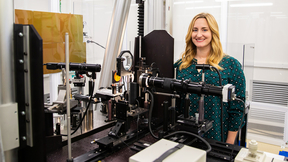
Throwing shade on optics damage
If the sun is too bright, you might don a pair of sunglasses or a hat to prevent glare from damaging your eyes. Researchers at Lawrence Livermore National Laboratory (LLNL) are using this same strategy to mitigate damage to valuable optics vital to the National Ignition Facility (NIF). Every time NIF fires, its lasers can harm the optics along its beamlines, causing…

Using NIF to study the sluggish pace of star formation
Editor’s note: The principal mission of Lawrence Livermore National Laboratory (LLNL)’s National Ignition Facility (NIF) is to support the National Nuclear Security Administration’s science-based Stockpile Stewardship Program — and with the achievement of fusion ignition in 2022 at NIF, LLNL is further exploring the possible use of nuclear fusion as a future energy source…
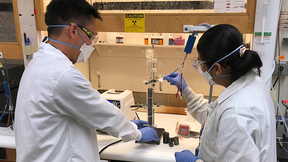
New technique converts excess renewable energy to natural gas
Four Lawrence Livermore National Laboratory (LLNL) researchers have partnered with Los Angeles-based SoCalGas and Munich, Germany-based Electrochaea to develop an electrobioreactor to allow excess renewable electricity from wind and solar sources to be stored in chemical bonds as renewable natural gas. When renewable electricity supply exceeds demand, electric-utility…
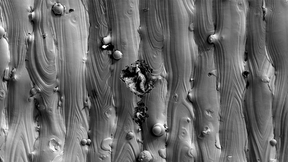
LLNL researchers uncover culprits behind pitting corrosion in 3D-printed stainless steel
Like a hidden enemy, pitting corrosion attacks metal surfaces, making it difficult to detect and control. This type of corrosion, primarily caused by prolonged contact with seawater in nature, is especially problematic for naval vessels. In a recent paper published in Nature Communications, Lawrence Livermore National Laboratory (LLNL) scientists delved into the mysterious…
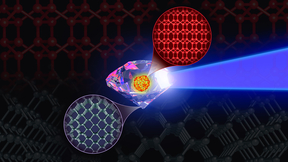
Supercomputer simulations of super-diamond suggest a path to its creation
Diamond is the strongest material known. However, another form of carbon has been predicted to be even tougher than diamond. The challenge is how to create it on Earth. The eight-atom body-centered cubic (BC8) crystal is a distinct carbon phase: not diamond, but very similar. BC8 is predicted to be a stronger material, exhibiting a 30% greater resistance to compression…
Energy I-Corps experience shines light on bringing specialty resin to the silicone 3D-printing market
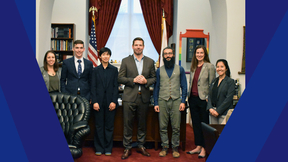
In the fall of 2023, Lawrence Livermore National Laboratory (LLNL) scientists Sijia Huang and Michael Ford participated in the Department of Energy’s Energy I-Corps Program, an immersive eight-week entrepreneurial boot camp that teaches scientists and engineers the tools of the trade for commercializing technology from the Lab to the marketplace. A major part of the…
‘Science on Saturday’ extends into March in Tracy
Lawrence Livermore National Laboratory’s (LLNL) popular outreach series, “Science on Saturday,” will continue its programming into March at the Grand Theatre Center for the Arts in Tracy, California. The talks are scheduled for March 2 and 9 and will focus on the theme “Magic of Materials.” The talks, which are geared toward middle and high school students, will begin at…
Lab employees recognized with Secretary of Energy’s Honor Awards
Lawrence Livermore National Laboratory (LLNL) employees, participating in five project teams, recently earned Department of Energy (DOE) Secretary’s Honor Awards. In addition, Karin King of the Livermore Field Office was honored for her role in the Leadership in Climate Action Team. Representing some of the highest internal, non-monetary recognition that DOE employees and…
Hot stuff: A new thermal pathway for a high explosive
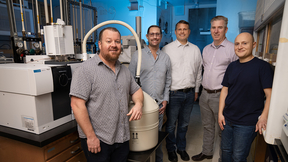
TATB (1,3,5-triamino-2,4,6-trinitrobenzene) is an important explosive compound because of its extensive use in munitions and world-wide weapons systems. Despite its importance, researchers have been trying to understand its response to temperature extremes for the past 50 years. A Lawrence Livermore National Laboratory (LLNL) team has uncovered a new thermal decomposition…
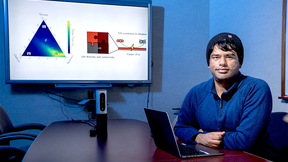
Looking at the importance of catalyst sites in electrochemical CO2 conversion
Intense research efforts have been directed toward studying the electrochemical conversion of CO2, a major greenhouse gas, into platform chemicals and fuels. The success of this technology can enable decarbonization of some of the largest CO2 emitters including steel, cement and chemical manufacturing industries. Copper is unique in its ability to convert CO2 at low…

Strategic Deterrence Academic Collaboration Team awards six scientists to support collaborative research
Six scientists at the Lawrence Livermore National Laboratory (LLNL) were recently granted awards through the Lab’s 2023 Academic Collaboration Team (ACT) annual call for proposals. Awards support university research partners for up to three years to perform research in collaboration with Lab scientists and offer an important way to build long-term connections with…
Lawrence Livermore’s popular 'Science on Saturday' lecture series returns to Las Positas College
Lawrence Livermore National Laboratory's (LLNL) popular lecture series, “Science on Saturday,” returns Feb. 3 and runs through Feb. 24. The series offers four different lectures with the theme, “Magic of Materials.” Each lecture is presented by leading LLNL researchers who are joined by high-school science teachers. Below is the schedule of lectures, which can also be…